Tuesday, April 12, 2022

Blog Post #4: 2nd EOTO - Joseph Pulitzer

Background

Pulitzer came from a wealthy family known for grain merchants in Hungary according to this article. With poor vision and weak lungs, he was rejected by the European army but came to the United States and became a soldier for the union army in the Civil War. After a short stint, he was honorably discharged and stayed in St. Louis where he worked a multitude of random jobs to stay afloat. He finally gained a job as a reporter for a newspaper known as Westliche Post. He was nominated for state legislature for the republican party and won. From that point forward his goal was to root out corruption within and outside legislation. After getting into a fight with one of his friends on the board regarding accusations of advantageous behavior in his position, Pulitzer accidentally shot him in the leg. From that point on, Pulitzer wasn’t regarded in the same light in the political realm and would not become elected again. He also eventually switched his political party to democratic.

Journalism Career

He sold his assets within his current newspaper to buy another and merged it with St. Louis Dispatch to create the newspaper, Post Dispatch, according to this article. The narrative that they served was to uncover corruption and seediness within St. Louis. They also told their audience that they are not affiliated with a certain political party as their motive was to deliver news and information without an objective. From tax fraud, to the underworld of gambaling, to political deception, Pulitzer left no rock unturned in the name of journalistic reporting. After making that newspaper the main publication in St. Louis, he moved to the Big Apple where he would become the owner of The New York Journal. These standards for his newspaper were not upheld as the need to win out won his values with the competing newspaper and owner William Hearst.

Yellow Journalism

It is characterized as a type of exaggerated news writing veered towards a certain narrative according to this article. Visually, the newspaper would include: big heading, multiple columns, salacious front page stories, bolded fonts, questionable sources, and illustrative drawings. In an effort to keep up with one another, Pulitzer and Hearst would try to one up one another without thought to accuracy or unbiasedness. Hearst and Pulitzer devoted a large portion of their newspapers to the struggle of independence in foreign countries that shed light on the cruelty of Spanish rulers and revolutionaries. While accomplishing this narrative, they ended up printing hyperbolic stories that appealed to people's emotions but were ultimately proved to be false. This portrayal is said to have been a defining factor in starting the Spanish-American War. Since Hearst and Pulitzer were primarily Democratic, the conservative press wanted to punish them for their misconduct in the news and spearheaded a boycott against both of their publications. Although newsstands did go along with the boycott and decided not to sell their papers, it added even more readership as curiosity and drama drew readers back to their newspapers. 

Comic Strips

Pulitzer is also deemed responsible for the creation and layout of a comic strip. This started with the illustration of “The Yellow Kid” which is an illustration poking fun of politics and society’s biggest figures. The drawings seemed to have a yellow filter over it which would contribute to the name “Yellow Journalism.” Although there had been comical drawings in the past, these comic strips were innovative because of their layout and the use of word balloons according to this article.


United States v. Press Publishing Co. (1911)

Pulitzer’s newspaper allegedly claimed that Theodore Roosevelt benefited from the sale of the Panama Canal. As a result, Roosevelt attempted to prosecute Pulitzer for libelous activities under the Assimilative Crimes Act of 1898 through which the state law would apply since the Post Office from where the newspapers were being distributed from was federally owned. The Supreme Court thwarted the charges and stated that the Assimilative Crimes Act of 1898 wasn’t meant to be used as a loophole for jurisdiction according to this article.

Pulitzer prize

Towards the end of his life, Pulitzer coordinated funds to be given to Columbia University to start one of the first graduate schools of journalism according to this article.He also gave the university a stipend for an award that would go to an accomplished journalist every year. The award is steered towards journalists who made an impact and exposed government corruption. Every May, the recipients are chosen in 21 different categories related to journalism and the arts. The stipend ranges from $10,000 to $15,000.

Saturday, April 9, 2022

Blog Post #3: 1st EOTO Review

These are the 3 presentations that I found most interesting.

Chicago Tribune

In the beginning, the newspaper was the mouthpiece for anti-slavery voices and was instrumental in the election of President Abraham Lincoln as the narrative veered towards a republican outlook. Their values coincided with the temperance movement which was an anti-alcohol initiative, and tended to write in a negative tone regarding foreigners and catholics. One of the most embarrassing moments of the newspaper had to do with the 1948 election. The newspaper had become solely right winged and decided to publish the republican candidate, Thomas Dewey as the winner before the results were conclusive. The other candidate won but the newspaper had already been published and made the news outlet look like a fool. One of its notable moments was when the Chicago Tribune was the first to publish the Watergate Tapes in 1974.

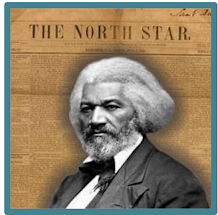
The North Star

        The North Star became one of the most monumental antislavery newspapers from 1848 to 1851. It was published by an African American abolitionist known as Frederick Douglass. The name of the newspaper is symbolic to the slaves who would look for the North Star in the sky to guide them to freedom. The newspaper would include current slavery issues, editorials, poetry, readings, and advertisements. Despite the effort that Frederick Douglas put into the publication, its financial status plummeted and as a result he decided to merge newspapers with abolitionist Gerrit Smith who owned Liberty Party Paper. The new publication became known as the Liberty Party Paper. 

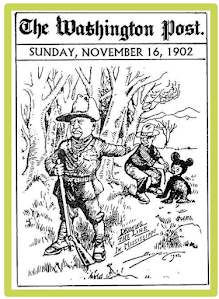
The Washington Post

Starting out in 1877, the newspaper started as a primarily dominant narrative but switched over to conservative views in 1889. They focused on  sensationalism and societal gossip and also incorporated cartoon drawing which was unique from other newspapers. These cartoons were highly innovative at the time because it allowed the public to interpret on their own. In one cartoon, they showed Theodore Roosevelt caring for a small bear cub which led the public to a certain narrative. During the Red Summer of 1919 the Washington Post showed its support for white supremacy and even reported front page coverage that highlighted where white men were going to meet to attack black men in Washington.

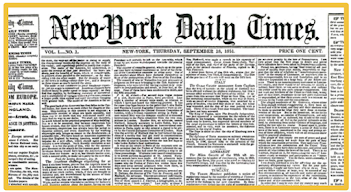
Blog Post #2: 1st EOTO - The New York Times


The New York Times was created on September 18, 1851, by Henry Jarvis Raymond, a journalist with political ties and George Jones, a banker. Originally the newspaper started under the name of The New-York Daily Times and was sold as a penny paper. The paper wished to contrast yellow journalism which consisted of exaggerated writing that veered toward a certain narrative. They’re editorial policy was based on unbiased, accurate reporting that moderated  opinion writing.

“We shall be Conservative, in all cases where we think Conservatism essential to the public good;—and we shall be Radical in everything which may seem to us to require radical treatment and radical reform. We do not believe that everything in Society is either exactly right or exactly wrong;—what is good we desire to preserve and improve;—what is evil, to exterminate, or reform” wrote Henry Jarvis Raymond according to this article.

Early on, it was seen as an early success because the paper set a pattern to appeal to a particular group of cultured and intellectual readers rather than a mass audience. Though the newspaper did suffer from ups and downs as they struggled to figure out how to maximize their audience. In a failed effort to branch off to the west coast, they produced a California edition called The Times of California according to this article, which would arrive via mail boat from New York. Though it was shut down as there was a long time delay from when the news actually occurred. Competition occurred as the state started creating their own newspapers.

As the United States entered the Civil War, The NewYork Times assembled an extra Sunday publication to offer its readers extra coverage during the war which would stay throughout other wars. 

After the death of George Jones in 1891, editors of the paper raised $1 million to buy it out and started printing under the New York Times Publishing Company. Around this time, the Panic of 1893 started and deeply hurt the newspaper financially. According to this article, the newspaper had an income of less than 9,000 and was losing $1,000 a day in 1896. The publishing company survived when the owner of Chattanooga Times, Adolph Ochs, gained a controlling interest in the company.


Notable Coverage

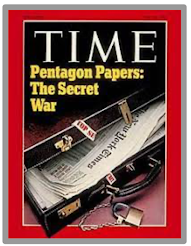
The “Pentagon Papers” were declassified files that revealed that the government downplayed its war actions in the Vietnam War which included coastal raids on North Vietnam and Marine Corps attacks that went unreported to the public. The whistleblower and Secretary of Defense, Robert McNamara directed a secret government study on American involvement in Vietnam. In an effort to cover up, the Nixon administration reported national security concerns and secured a restraining order which would restrict the New York Times from further publishing the rest of the papers. The Court dissolved the restraining order and allowed the Times to continue with publication under the reasoning that Prior Restraint is unconstitutional.

Reporting during the Russo-Japanese War in 1904, the New York Times was able to obtain  immediate wireless transmissions from one of the war’s naval battles during the Battle of Port Arthur. This coverage of this event was monumental as it was one of the first speedy turnaround times regarding war events and caused the publishing company to stand out amongst the other newspapers. 

The New York Times v. Sullivan (1964) case began when an article published by The New York Times unintentionally reported small inaccurate details regarding the mistreatment of civil rights protesters by the police force in Montgomery, Alabama. Police commissioner Sullivan sued the newspaper for defamation as a result. Both the county court and the Supreme Court of Alabama sided with Sullivan though when the case went to the Supreme Court of the United States, the verdict sided with the New York Times and led to a new term that needed to be proven for defamation cases regarding public officials. They must prove actual malice which is the intentional action to create harm to the individual.

Saturday, April 2, 2022

Blog Post #1: Why am I a journalism major?

Growing up I really didn’t have a strong passion for a certain career field like some people do. Everyone around me seemed to know exactly what they wanted to do without any doubts. I didn’t understand this because how are we supposed to dedicate our life to a profession at the tender age of 18 when we’ve never actually experienced the best and worst side to the job ourselves. It always seemed ludicrous to me and was something I always struggled with in high school to understand.

As I was trying to figure out my major, I came to the understanding that my English class was the most interesting to me and where I excelled most. I liked to dissect literature and figure out the symbolism behind texts and when writing essays, I enjoyed creating flowing paragraphs that articulated my thoughts. I loved to decode the mini stories in every sentence and figure out what the author was trying to convey and how they were trying to do that. Figuring out why an author chose a certain way to write a text or analyzing the message that is being percieved had always been super interesting to me. Though that realization didn’t really get me anywhere because I knew I didn’t want to teach and I knew I wasn’t creative enough to write a book. It was more of a closeted passion that came along with my love of reading. Both of those aspects were dead ends when it came to a career. 

History was another class I found very interesting in highschool because it was the first time I had ever been confronted with the government’s wrongdoing which has been an occurrence since the beginning. I liked when my mind was expanded and my values stretched as teacher’s would make me rethink what I thought for sure was correct. Growing up, we naturally have rose-colored glasses on when it comes to the government, military, or any type of authority as we’re taught from an early age to be law abiding citizens. Though what I learned is that there's corruption in every facet of society and usually more in a position of power. Nowadays people are so blinded and compartmentalized within their political party that it’s difficult to divert that thinking. There’s always so much going on in the world, and it’s important to understand the finer details. As journalists, our job is to shed an unbiased light on misbehavior and deception. 

When journalism came to mind, I always thought about the newspapers that would write about daily crimes in the community or the columnist that wrote about tips and tricks. In reality, journalism can cover a lot of different positions. Broadcast news report is where I’m headed to at the moment as the working environment of collaborating with others as well as being at the center of action seems to suit me. I always wondered what it would be like to be a reporter, being in the midst of chaos and having to document that to the public.

With this in mind, it seemed that journalism matched my strengths in writings and also suited my curiosity to learn more.